Final Fantasy III
Final Fantasy III

- Title
- Final Fantasy III
- Developer
- Square
- Publisher
- Square
- Director
- Hironobu Sakaguchi
- Producer
- Masafumi Miyamoto
- Artists
- Koichi Ishii
Kazuko Shibuya
Yoshitaka Amano - Writers
- Kenji Terada
- Composer
- Nobuo Uematsu
- Series
- Final Fantasy
- Platforms
- Family Computer
- Release
- JP: April 27, 1990
- Genres
- turn based role-playing
- Mode
- single-player
Final Fantasy III is a turn based role-playing game by Square. It is the second installment of the Final Fantasy series and was directed by Hironobu Sakaguchi.
Synopsis
With the power of light nearly eclipsed by the power of darkness, only the crystals' four chosen adventurers can save the world.
Experience the iconic job changing system first introduced in FFIII - switch jobs at will and use various abilities as you progress in the game. Change into a variety of classes like Warrior, Monk, White Mage, Black Mage, Dragoon, Evoker, or even call monsters to do your bidding with as a Summoner.
Enjoy the exciting third installment in the FINAL FANTASY series!
— Store Page of 'Final Fantasy III' on Steam
Setting
The unnamed world is protected by four elemental crystals. 1000 years prior, an ancient civilisation overused the power of light and triggered a disaster by upsetting the balance between light and darkness. This summoned the Cloud of Darkness who wanted to return the world to nothingness. This conflict was ended by the Warriors of Light and Warriors of Darkness. The ancient civilastion was destroyed and balance was restored.
At the beginning of the game darkness is taking over the world again, disrupting the balance and spawning monsters.
Story
Four orphans of the village of Ur are chosen by the dying crystals. Dubbing them the Warriors of Light, the dying Wind Crystal grants them the last of its powers and bestow the task of restoring the balance to them. They take off exploring the Floating Continent, and encounter several people like the princess Sara, Desch and Cid.
When they reach the Fire Crystal, it is under attack from servants of the mage Sande. After defeating them, it grants the Warriors of Light its power.
Cid gives them the Invincible, an airship that allows the Warriors of Light to travel to the surface world, which is nearly completely flooded. After facing several trials the Water Crystal grants them its blessing. After that, they meet Unei and Doga - students of the Magus Noah - who reveal to them that Xande attacked the crystals to halt time's flow to become immortal. After gaining the final blessing from the Earth Crystal and receiving keys from Xande's servants, they breach into his stronghold - the Crystal Tower.
The Warriors of Light defeat Xande, but the imbalance still summons the Cloud of Darkness again. The Cloud of Darkness absorbs Xande and kill the Warriors of Light. Unei and Doga sacrifice themselves to revive the Warriors of Light, allowing them to enter the World of Darkness. There they ally with the Warriors of Darkness. They sacrifice themselves to weaken the Cloud of Darkness, giving the Warriors of Light the Chance to kill the Cloud of Darkness. The crystals are revived and the balance is restored, and everyone is able to return to their old lives[1].
References in Final Fantasy XIV
Legacy
- The servers Gysahl and Saronia referred to the village and kingdom within Final Fantasy III.
A Realm Reborn
- The Onion Helm is a reward for puchasing the Collector's Edition of Final Fantasy XIV. The rest of the gear is available in The Labyrinth of the Ancients.
- The name of the Enterprise for an airship appears for the first time in Final Fantasy III.
- The Crystal Tower Raid Series is inspired by Final Fantasy III:
- The Organisation NOAH is named after the Magus Noah.
- The The Labyrinth of the Ancients is a reference to the Ancient's Maze.
- The Bosses Thanatos, King Behemoth and Phlegethon are references to the bosses in Final Fantasy III.
- Syrcus Tower is a direct reference to the Syrcus Tower in Final Fantasy III.
- The Bosses Scylla, Glasya Labolas, Amon and Xande are references to the bosses in Final Fantasy III.
- During casting its abilities Glasya Labolas takes the same stance as the battle sprite in Final Fantasy III.
- Xande's fear of mortality and making a pact with the voidbeing Cloud of Darkness is a direct reference to the story of Final Fantasy III.
- Doga and Unei are named after the two characters in Final Fantasy III.
- The historical figures from the Allagan Empire are named Desch and Salina, referencing to the characters appearing in Final Fantasy III.
- The Wind-up Onion Knight is a reference to the Onion Knight sprite in Final Fantasy III.
- Nepto Dragon is named after a creature appearing in Final Fantasy III.
- The Evoker's Attire and the upgraded Summoner's Attire is a reference to the Final Fantasy III job "Evoker" becoming the "Summoner".
- The weapons that could be obtained from Rowena with the rewards from the quest Primal Focus are named after weapons from Final Fantasy III.
- The Scholar, Summoner, Bard, and Dragoon jobs originate from this game.
- The following orchestrion rolls have been rearranged:


| Original Theme | Theme |
|---|---|
| Altar Cave | Hubris |
| Battle 2 | Tumbling Down |
| Dorga Theme | Now I Know the Truth |
| Crystal Tower | Out of the Labyrinth |
| The Crystal Tower (Theme) | Out of the Labyrinth |
| Eternal Wind (Map Theme) | Eternal Wind |


Heavensward
- The Wind-up Magus and Wind-up Viking enemies in The Antitower are based on the Magus and Viking job sprites.
- The Warriors of Darkness are based on the same characters from Final Fantasy III
- Similar to the group in Final Fantasy III, their world has been consumed by a Flood of Light.
- The job titles are the same as those in Final Fantasy III: Devout, Magus, Ranger and Knight
- The Orison Attire is inspired after the White Mage sprite from Final Fantasy III.

Shadowbringers
- The following orchestrion rolls have been rearranged:
| Original Theme | Theme |
|---|---|
| Eternal Wind (Map Theme) | Eternal Wind - Shadowbringers |

Endwalker
- The Sage job originates from this game.

Gallery
-
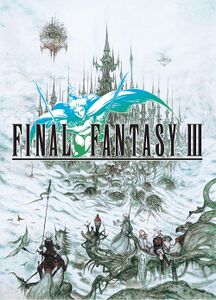 Cover used for the Nintendo DS and PSP Version of Final Fantasy III

References
- ↑ The Complete Story of Final Fantasy III, Birds of Play, 29.03.2026